Mingus’s laser gun
The Robot Who Looked Like MeMingus’s laser gun is a blue-steel automatic disguised in the case of a Colt .45, but it fires no projectile: its laser-diffusion beam first paralyzes and then kills. It changes the balance of power when Mordecai Gleister uses it to halt a crowd and proclaim himself Emperor Mingus; later, its unexpected effect on Mordecai, its passage through the hands of Hieronymous Gleister and Charlie Gleister, and its use in Charlie’s suicide entangle the weapon with the recurring transfer of imperial roles.
Design and Stated Operation
The gun’s appearance and mechanism are deliberately at odds. It looks like a familiar automatic, but Mordecai explains that it is “not a projectile weapon” and operates on a laser-diffusion principle. The Colt .45 casing makes the device legible as a conventional firearm even as its actual danger lies in a different technology. Its blue-steel body and pocket concealment give that concealed difference a physical form: the crowd sees a weapon only once Mordecai draws it, and learns what it can do through his warning.
Mordecai specifies the weapon’s effects and limits. At fifteen feet, its first effect is paralysis; death follows seconds later if the beam is not turned off. That interval makes the gun more than a simple instrument of instant killing. Its threat includes a staged progression from incapacitation to death, while the possibility of turning off the beam makes the outcome, at least in the statement, dependent on continued operation. Mordecai tells the audience to include the weapon in their calculations, presenting its technical properties as a practical constraint on every possible response.
The Gun as an Instrument of Rule
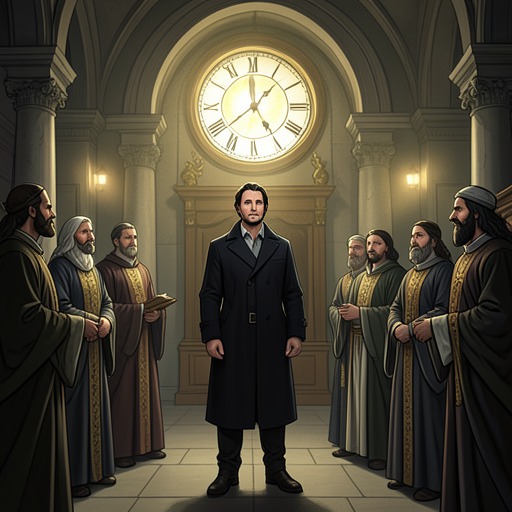
The gun first becomes politically decisive at the gathering where Hieronymous Gleister identifies Mordecai as Mingus, the Emperor, and calls for the crowd to seize him. Egon and Hieronymous move toward Mordecai, joined by other Gleisters climbing onto the stage, but the movement stops when Mordecai draws the automatic and aims it at Egon. Its appearance interrupts collective action before any shot is fired.
Mordecai orders everyone except Chairman Egon and Hieronymous to sit, making their lives conditional on the others’ good behavior. His account of the gun turns that threat into a public demonstration of control: the weapon does not merely protect its holder but dictates where the audience may sit and who may remain standing. After pausing for the warning to take effect, he smiles and declares, “My worthy brothers and loyal subjects, the Emperor Mingus greets you.” The contrast between the deferential address and the armed command makes the gun part of the performance through which he claims authority. His imperial greeting follows, rather than replaces, the act of coercion that has secured the room’s attention.
Succession and Reversal
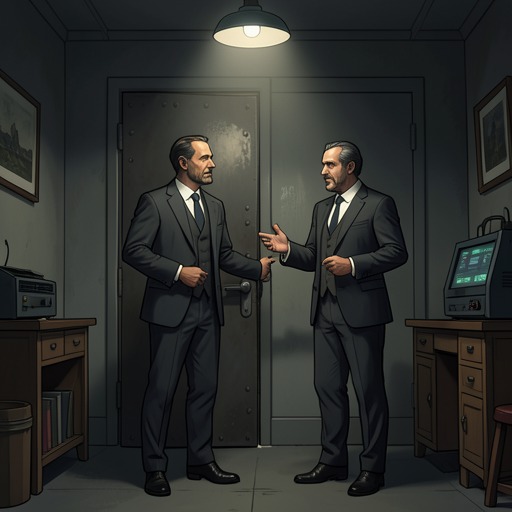
Egon later asks for the gun as part of his bid to become Emperor. He argues that time travel necessarily involves duplication and that “nothing happens for the first time”; Mordecai, as the first Emperor, cannot remain the only one if the Emperor-line of probability is to occur. Egon offers to let Mingus go in peace if he hands over the weapon, treating possession of the gun as both leverage and a means of taking up the imperial role. Hieronymous supports the argument that time travel requires a second Emperor, and Mordecai agrees to give Egon the gun.
The transfer does not happen as promised. Mordecai aims at Egon and pulls the trigger, but Mordecai himself goes rigid and falls. The weapon drops from his hand and clatters across the floor to Hieronymous’s feet. The scene reports the reversal without explaining its mechanism: the intended target survives, while the gun’s holder dies. Hieronymous picks it up, examines Mordecai, and confirms his death; Egon then observes that they seem to have a new Emperor. The gun’s change of hands thus accompanies an abrupt change in rule, but the event unsettles any assumption that its holder can reliably direct its violence.
Custody Across the Gleister Cycle
Later, Hieronymous asks Mingus whether he still has the laser gun. Mingus hands it over, and Hieronymous puts it in his pocket before setting his time machine. This return to pocket concealment echoes Mordecai’s first appearance with the weapon, while the movement between holders places the gun inside the story’s changing sequence of encounters and imperial identities.
The narrative subsequently places the weapon with Charlie Gleister at a brook where he had fished as a boy. Charlie looks at it, sits beside the water and a familiar oak, then puts its muzzle in his mouth and pulls the trigger. The account states that he dies. The same device that had held a public assembly in fear is now used in an isolated act of self-destruction; its effect is no longer a threat to subjects or a failed attack on a rival, but the means by which Charlie ends his life.
The cycle does not end with that death. Charlie opens his eyes in the imperial audience room, where the latest statistics report more than twelve million Gleisters settled and more arriving every minute. He gives the laser gun to the young Egon Gleister, who departs in his time machine. Charlie remains to take his turn at imperial duties, as the other Gleisters must take their turns in the roles until only he is left. The gun’s reappearance makes it a material link between the suicide and the renewed succession: it passes onward even as the cycle assigns its roles again.
Narrative Significance
The gun’s importance lies in the discrepancy between its stable physical identity and its shifting uses. It is always the same recognizable automatic, yet it serves in turn as concealed threat, instrument of a public claim to sovereignty, object of negotiation, cause of an unforeseen death, and means of Charlie’s suicide. Its repeated transfer gives the succession cycle a concrete object that can be carried from one imperial encounter to another, while its unpredictable violence resists the characters’ efforts to treat power as something secured merely by possession.
The device also makes the story’s recurrence tangible without resolving its paradoxes. It can be handed from one figure to the next, used in an attempted transfer of power, and present again when the Gleister sequence begins anew. But its effect cannot be reduced to the intention of the person aiming it: when Mordecai fires at Egon, Mordecai dies instead. In that reversal and in the gun’s later return to Egon, the object connects the immediate danger of imperial rule to a cycle in which the roles and their instruments persist beyond any one holder.